
Spoiler Warning: This article contains major spoilers from the Jujutsu Kaisen manga, including developments involving Sukuna, Tsumiki, Mahoraga, the Ten Shadows Technique, and the manga’s final chapters.
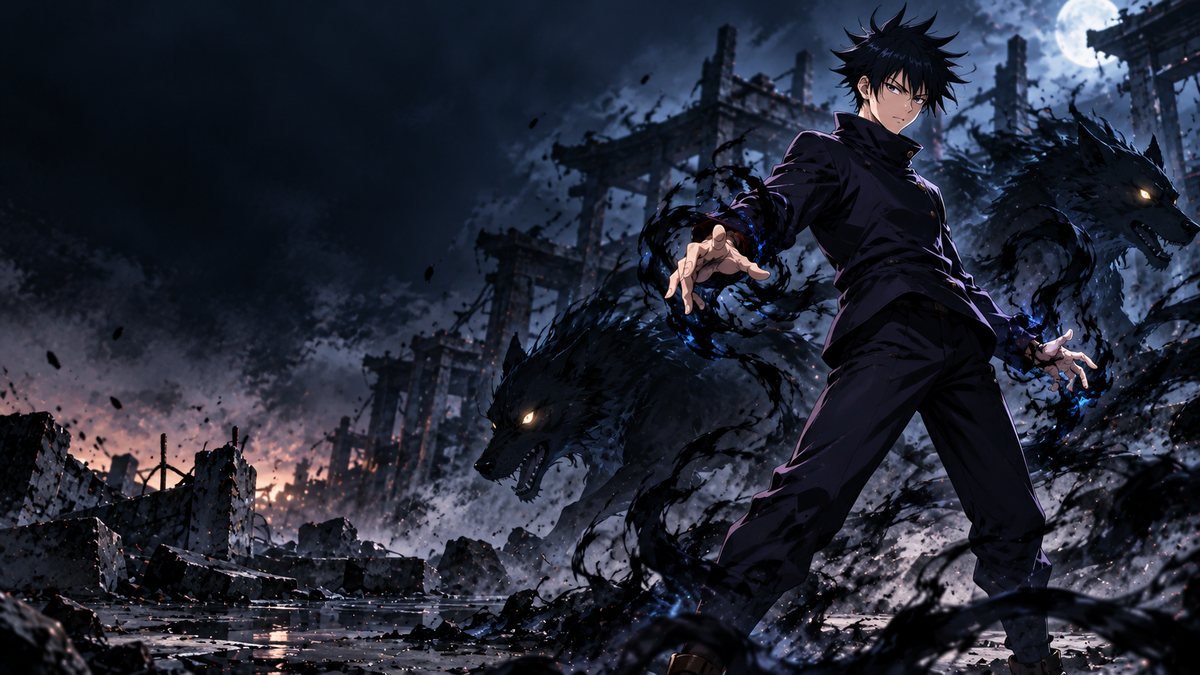
Megumi Fushiguro is one of the most important characters in Jujutsu Kaisen. Introduced as a serious and reserved first-year student at Tokyo Jujutsu High, he quickly becomes much more than Yuji Itadori’s first ally in the world of jujutsu. His Ten Shadows Technique gives him one of the series’ most versatile inherited abilities, while his complicated family history and connection to Sukuna make him central to the larger story.
Unlike characters who openly seek power, Megumi often approaches battles from a tactical perspective. He studies his opponents, uses the environment intelligently, and combines his shikigami in creative ways. His willingness to risk his own life also becomes an important part of his character.
The official Jujutsu Kaisen character profile identifies Megumi as a Tokyo Jujutsu High first-year and Grade 2 sorcerer who uses the Zenin family’s inherited Ten Shadows Technique. It also emphasizes the belief he developed through his past experiences: protecting the people he personally considers important.
Table of Contents
Who Is Megumi Fushiguro?
Megumi Fushiguro is a jujutsu sorcerer and one of the main characters in Jujutsu Kaisen. He is a first-year student at Tokyo Jujutsu High alongside Yuji Itadori and Nobara Kugisaki.
When the story begins, Megumi is already operating as a capable sorcerer. Unlike Yuji, who is only beginning to discover the world of curses, Megumi understands the danger of cursed objects and cursed spirits from the start.
His first major connection with Yuji comes when he investigates a cursed object at Yuji’s school. That encounter ultimately leads to Yuji becoming the vessel of Ryomen Sukuna and changes the direction of both characters’ lives.
Megumi is officially classified as a Grade 2 sorcerer. The official character profile also notes that he was the only first-year permitted to undertake solo missions at the beginning of the story, highlighting his unusual ability and potential.
Megumi Fushiguro’s Personality
Megumi is quiet, serious, observant, and often blunt. He rarely wastes words and generally avoids the exaggerated confidence that some other characters display.
However, his reserved personality does not mean that he lacks strong emotions. Much of Megumi’s personality is built around his personal definition of who deserves to be protected.
He does not believe that everyone can or should be saved equally. Instead, he places greater value on protecting people he considers good or important to him. This philosophy becomes one of the most important themes in his character development.
His decisions can sometimes appear reckless because he is willing to sacrifice himself when he believes doing so is necessary. This tendency is both one of his greatest strengths and one of his weaknesses.
Megumi’s intelligence is another defining trait. Rather than depending entirely on raw power, he frequently looks for unusual solutions during battles. He uses terrain, shadows, shikigami combinations, and his opponent’s expectations to create openings.
Maki Zenin: Age, Height, Powers, Backstory and Abilities
Megumi Fushiguro’s Background
Megumi’s family history is closely connected to the Zenin clan, one of the major jujutsu families.
His father is Toji Fushiguro, formerly known as Toji Zenin. Toji’s unusual relationship with cursed energy and the Zenin family becomes important to understanding why Megumi’s existence matters to the clan.
Megumi was raised alongside his older stepsister, Tsumiki Fushiguro. The official character profile describes Tsumiki as Megumi’s one-year-older stepsister. After their parents disappeared, the two lived together, but Tsumiki later became bedridden because of an unexplained curse.
Tsumiki becomes one of the central reasons behind Megumi’s actions. His desire to protect her is not simply a background detail; it influences many of his choices throughout the story.
Satoru Gojo also becomes an important figure in Megumi’s life. Gojo recognizes Megumi’s potential and takes an interest in his future as a sorcerer.
Megumi Fushiguro’s Powers and Abilities
Megumi’s abilities are based primarily around his Ten Shadows Technique, but his effectiveness does not come from that technique alone.
He is a capable close-range fighter and can combine physical attacks with his shikigami and shadow-based abilities. More importantly, he possesses strong tactical awareness.
His fighting style usually involves several layers of strategy. He can summon a shikigami to distract an opponent, use another to attack from a different direction, manipulate the battlefield, and then use his own movement to exploit the opening.
This versatility makes him difficult to predict.
Megumi also develops his cursed technique throughout the series rather than beginning with a completely mastered ability. His growth is therefore closely tied to his willingness to understand the full potential of the Ten Shadows Technique.
What Is the Ten Shadows Technique?
The Ten Shadows Technique is an inherited cursed technique associated with the Zenin family.
Megumi uses shadows as the medium through which he summons and controls shikigami. The technique gives him access to multiple creatures with different abilities, making it one of the most flexible cursed techniques in the series.
The official character profile specifically identifies the Ten Shadows Technique as the inherited technique Megumi uses.
One of the most interesting aspects of the technique is that its value depends heavily on how creatively the user applies it.
Megumi does not simply summon creatures and command them to attack. He uses their abilities to create combinations, control space, gather information, defend himself, and pressure opponents from several directions.
Megumi’s Shikigami
The shikigami associated with Megumi’s Ten Shadows Technique each serve different purposes.
Divine Dogs are among Megumi’s most recognizable summons. They are useful for tracking, attacking, and sensing targets. After one of the Divine Dogs is lost, its power is inherited by the remaining dog, creating Divine Dog: Totality, a more powerful form.
Nue provides aerial mobility and electrical attacks, making it useful when Megumi needs to attack from above or control a wider area.
Great Serpent is a large snake-like shikigami that can restrain opponents and create openings, although it is eventually destroyed.
Toad is particularly useful for grabbing and moving people. It gives Megumi another way to control an opponent without relying solely on direct attacks.
Max Elephant is much larger than several of Megumi’s other summons and can produce enormous quantities of water. Its size and abilities make it valuable for controlling the battlefield.
Rabbit Escape summons a large number of rabbits. Individually they are not powerful combatants, but their numbers make them extremely useful for distraction, concealment, and escape.
The technique also contains more dangerous possibilities, culminating in the Eight-Handled Sword Divergent Sila Divine General Mahoraga.
What Is Mahoraga?
Mahoraga is the most infamous shikigami associated with the Ten Shadows Technique.
Unlike Megumi’s more conventional summons, Mahoraga represents an enormous risk. Its defining ability is adaptation: after experiencing an attack or phenomenon, Mahoraga can gradually adapt to it.
That ability makes Mahoraga exceptionally dangerous.
However, Megumi’s relationship with Mahoraga needs to be described carefully. Simply saying that “Megumi controls Mahoraga” is misleading.
Megumi uses the Ten Shadows Technique, but Mahoraga is not something he casually commands like Divine Dog or Nue. The ritual surrounding Mahoraga is extraordinarily dangerous, and Megumi’s early attempts to invoke it are effectively acts of desperation.
This is one reason Mahoraga is so important to understanding Megumi. The shikigami represents both the enormous potential of his inherited technique and the destructive consequences of pushing that technique beyond his current limits.
Mahoraga later becomes central to Sukuna’s interest in Megumi’s technique.
Megumi’s Domain Expansion: Chimera Shadow Garden
Megumi’s Domain Expansion is called Chimera Shadow Garden.
Unlike a conventional completed Domain Expansion with a fully developed barrier and guaranteed-hit effect, Megumi’s version is initially incomplete.
Nevertheless, it dramatically increases the possibilities of his Ten Shadows Technique.
Within Chimera Shadow Garden, Megumi can spread shadows across the environment and use them to enhance his technique. The domain allows his shikigami-based combat style to become considerably more flexible.
One of the clearest demonstrations of this ability occurs during Megumi’s fight against Reggie Star in the Culling Game.
The official anime’s Culling Game material describes Megumi using the surrounding space of a gymnasium to activate his incomplete Domain Expansion, Chimera Shadow Garden. He ultimately defeats Reggie after a tactical battle in which Megumi uses the environment as part of his strategy.
This battle is important because it demonstrates that Megumi’s greatest advantage is not simply the power of his technique. It is his ability to turn limited resources into a workable strategy.
Megumi Fushiguro and Yuji Itadori
Megumi and Yuji begin their relationship under unusual circumstances.
Megumi initially sees Yuji as someone connected to an extremely dangerous cursed object. However, their relationship gradually becomes a genuine friendship.
The two are very different.
Yuji is physically gifted, emotionally open, and naturally inclined to connect with people. Megumi is more reserved and analytical.
Despite those differences, they complement each other well in battle.
Yuji’s direct physical pressure can create opportunities for Megumi’s shikigami, while Megumi’s tactical thinking can help Yuji understand how to approach a difficult opponent.
Their relationship also becomes emotionally important. Megumi repeatedly demonstrates that he does not view Yuji merely as another student. Their bond becomes one of the central relationships in the series.
Megumi Fushiguro and Satoru Gojo
Gojo’s relationship with Megumi is different from his relationship with Yuji.
Gojo recognizes Megumi’s potential early and takes responsibility for helping guide him.
The connection is also tied to Megumi’s father, Toji Fushiguro. Gojo’s history with Toji gives his relationship with Megumi an additional layer of complexity.
Gojo understands that Megumi possesses a rare inherited technique with extraordinary potential.
The Ten Shadows Technique is significant enough that it becomes part of the larger history of the Zenin family and its strongest sorcerers. Gojo therefore sees Megumi not merely as a talented student, but as someone capable of reaching an exceptional level.
Megumi Fushiguro and Tsumiki
Tsumiki is one of the most important people in Megumi’s life.
As his older stepsister, she represents the person Megumi has spent much of his life trying to protect. The official character profile confirms that Tsumiki lived with Megumi after their parents disappeared and later became bedridden because of an unexplained curse.
Her situation eventually becomes connected to the Culling Game, turning Megumi’s personal motivation into one of the major story conflicts.
This relationship also explains an important part of Megumi’s worldview. His willingness to protect people is not an abstract ideal. It comes from personal experience and attachment.
Megumi Fushiguro and Sukuna
Major Manga Spoilers
Sukuna’s interest in Megumi becomes one of the biggest mysteries surrounding the character.
From relatively early in the series, Sukuna pays unusual attention to Megumi and his Ten Shadows Technique. As the story progresses, it becomes clear that Sukuna sees potential in the technique that goes far beyond what Megumi has demonstrated.
Eventually, Sukuna takes control of Megumi’s body.
This changes Megumi’s role in the story completely. He is no longer simply fighting alongside Yuji and the other sorcerers; his body and cursed technique become part of Sukuna’s strategy.
Sukuna’s use of the Ten Shadows Technique demonstrates just how powerful and versatile the inherited technique can become when combined with a vastly more experienced and powerful sorcerer.
However, this also becomes one of Megumi’s greatest tragedies. His body is being used while his consciousness struggles under Sukuna’s control.
The story later reveals that Megumi’s resistance still matters.
During the final confrontation, Yuji’s attacks target the separation between Sukuna and Megumi, while Nobara’s Resonance creates a crucial opening. Megumi ultimately breaks free from Sukuna’s control. Chapter 268 marks his reunion with his allies after Sukuna is defeated.
Megumi Fushiguro’s Character Development
Megumi’s character development is one of the quieter but most important arcs in Jujutsu Kaisen.
At first, his worldview is heavily centered on selective protection. He is willing to sacrifice himself for people he considers worth saving, even when doing so makes little practical sense.
Over time, however, the consequences of that mentality become increasingly serious.
His conflict with Sukuna forces Megumi to confront the destructive side of his own willingness to give up on himself.
After being freed from Sukuna, Megumi does not simply return to exactly who he was before. His experience changes the way he thinks about living and about what he owes to others.
His final development is especially meaningful because he begins to understand that survival itself can be an act of responsibility.
The manga’s ending reinforces this change. In Chapter 271, Megumi works alongside Yuji and Nobara on another case, showing that he has returned to active work rather than remaining defined by what happened to him. The official MANGA Plus listing confirms Chapter 271 as the completed manga’s final chapter.
Megumi’s Most Important Battles
Megumi vs. Sukuna
Their early encounter establishes an important contrast between Megumi’s developing technique and Sukuna’s overwhelming power.
More importantly, it shows that Sukuna notices something unusual about Megumi’s potential.
Megumi vs. Finger Bearer
This battle demonstrates how far Megumi is willing to push himself when facing a threat beyond his current level.
It also introduces the idea that Megumi may possess abilities he has not yet fully understood.
Megumi vs. Reggie Star
The fight against Reggie is arguably one of the best demonstrations of Megumi’s tactical intelligence.
Rather than overpowering Reggie directly, Megumi manipulates the battlefield, uses his shikigami creatively, and ultimately activates Chimera Shadow Garden in an incomplete form.
The official anime episode description specifically emphasizes how Megumi lures Reggie into the gymnasium and transforms the available space into the basis of his Domain Expansion.
Megumi and the Mahoraga Ritual
The Mahoraga ritual represents a different side of Megumi’s fighting style.
Instead of being a conventional victory strategy, it shows how Megumi is sometimes prepared to gamble his own life when he believes there is no other way forward.
This tendency becomes increasingly important to understanding his character.
Megumi’s Role in the Final Battle
Megumi’s final major role is less about physically fighting Sukuna himself and more about resisting from within.
His struggle becomes part of the larger effort by Yuji and the others to separate Sukuna from his body.
His eventual return gives emotional weight to the conclusion of his story.
Ryomen Sukuna: Age, Height, Powers, Backstory and Abilities
Why Is Megumi Fushiguro So Popular?
Megumi’s popularity comes from a combination of character design, personality, abilities, and narrative importance.
His quiet personality gives him a different presence from more openly expressive characters such as Yuji and Gojo.
His Ten Shadows Technique also gives him one of the most visually distinctive fighting styles in the series.
But his appeal goes beyond cool abilities.
Megumi has meaningful relationships with Yuji, Tsumiki, Gojo, and his father. His personal philosophy creates genuine conflicts, and his decisions often have consequences beyond the immediate battle.
He is also a character whose potential is repeatedly discussed without being treated as automatically limitless. That distinction makes his progression more interesting.
Megumi Fushiguro: Strengths and Weaknesses
Strengths
Tactical intelligence: Megumi frequently analyzes opponents rather than attacking without a plan.
Versatility: The Ten Shadows Technique gives him access to different shikigami with different functions.
Battlefield control: His shadows and shikigami allow him to influence the positioning and movement of opponents.
Adaptability: Megumi is capable of changing his strategy when his original plan fails.
Determination: He is willing to take enormous risks when protecting someone matters to him.
Weaknesses
Self-sacrificial tendencies: Megumi can underestimate the value of his own life.
Incomplete Domain: Chimera Shadow Garden begins as an incomplete Domain Expansion.
Limited mastery: For much of the series, Megumi is still developing his understanding of the Ten Shadows Technique.
Emotional pressure: His concern for Tsumiki and the people close to him can affect his decisions.
Physical and cursed-energy limits: Having a powerful inherited technique does not mean Megumi can use every part of it without consequences.
Megumi Fushiguro’s Final Status
Major Manga Spoilers
By the conclusion of the manga, Megumi survives the final conflict with Sukuna and is reunited with Yuji and Nobara.
Chapter 268 shows Megumi waking after being separated from Sukuna and reuniting with his friends.
Chapter 271 then presents Yuji, Megumi, and Nobara working together again on a new case. Megumi remains analytical and practical, but the final mission also demonstrates that the trio’s dynamic has returned in a changed world.
This ending is important because Megumi’s story does not conclude with him becoming the strongest sorcerer or mastering every possible aspect of the Ten Shadows Technique.
Instead, it concludes with him continuing to live and work alongside the people who matter to him.
That is a fitting resolution for a character whose entire philosophy was built around deciding who was worth protecting.
Frequently Asked Questions
Who is Megumi Fushiguro?
Megumi Fushiguro is a first-year student at Tokyo Jujutsu High and a Grade 2 jujutsu sorcerer who uses the inherited Ten Shadows Technique.
How old is Megumi Fushiguro?
Megumi is introduced as a first-year student at Tokyo Jujutsu High. His exact age can vary depending on the point in the timeline being discussed, so an article should avoid presenting an unsupported single age without specifying the story period.
What is Megumi Fushiguro’s Ten Shadows Technique?
The Ten Shadows Technique is an inherited Zenin-family cursed technique that allows its user to summon and utilize shikigami through shadows. Megumi is its primary user in the main story.
What shikigami can Megumi summon?
Megumi uses several shikigami, including Divine Dogs, Nue, Toad, Great Serpent, Max Elephant, Rabbit Escape, and other Ten Shadows summons. Their abilities give him options for tracking, attacking, defending, distracting enemies, and controlling the battlefield.
What is Megumi’s Domain Expansion?
Megumi’s Domain Expansion is called Chimera Shadow Garden. It is initially incomplete but significantly expands the possibilities of his Ten Shadows Technique.
Can Megumi control Mahoraga?
Megumi’s early use of Mahoraga should not be described as ordinary control. The ritual is extremely dangerous, and Mahoraga represents a major risk within the Ten Shadows Technique.
Why does Sukuna want Megumi?
Sukuna becomes interested in Megumi because of the potential of the Ten Shadows Technique. Its versatility and Mahoraga’s adaptation ability make it extremely valuable to him.
Who is Megumi’s sister?
Tsumiki Fushiguro is Megumi’s older stepsister. The official character profile states that she is one year older and lived with Megumi after their parents disappeared.
Is Megumi related to the Zenin family?
Yes. Megumi is connected to the Zenin family through his father, Toji Fushiguro. His use of the Zenin family’s inherited Ten Shadows Technique is another major part of that connection.
How powerful is Megumi Fushiguro?
Megumi is a highly talented young sorcerer with an exceptionally versatile inherited technique. His strength comes from the combination of Ten Shadows, tactical intelligence, shikigami, and his ability to adapt during combat. However, his potential and actual level of mastery should not be treated as the same thing.
Conclusion
Megumi Fushiguro stands out in Jujutsu Kaisen because his story is about much more than becoming stronger.
His Ten Shadows Technique gives him one of the series’ most flexible cursed techniques, while his battles demonstrate how much intelligence and creativity can matter alongside raw power. His relationships with Yuji, Tsumiki, Gojo, and Sukuna give his character arc emotional weight, while his struggle with self-sacrifice adds another layer to his development.
His journey through the Culling Game, his incomplete Chimera Shadow Garden, the danger of Mahoraga, and his time under Sukuna’s control all push him toward a more mature understanding of what it means to live for other people.
By the end of the manga, Megumi is still recognizably the same quiet and analytical sorcerer introduced at the beginning. But he has endured experiences that fundamentally change how he views himself and his future.
That combination of powerful technique, strategic thinking, personal conflict, and understated character growth is what makes Megumi Fushiguro one of the most memorable characters in Jujutsu Kaisen.
2 thoughts on “Megumi Fushiguro: Powers, Ten Shadows Technique, Mahoraga, and Character Explained”