
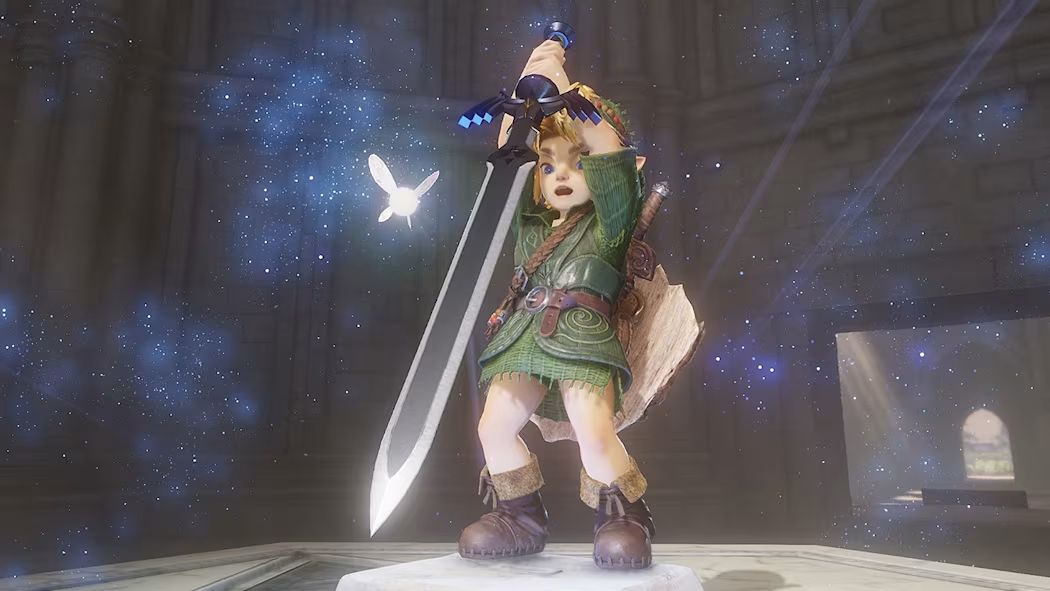
The Zelda Ocarina of Time Remake is bringing one of Nintendo’s most celebrated adventure games to a new generation of players. Originally released for the Nintendo 64 in 1998, The Legend of Zelda: Ocarina of Time follows Link on a journey across Hyrule to stop Ganondorf from claiming the legendary Triforce. The upcoming remake reimagines this adventure with redesigned visuals, fully voiced cutscenes, expanded character dialogue, orchestral music, and modernized controls.
Nintendo officially announced the game during its September 2026 presentation celebrating the 40th anniversary of The Legend of Zelda series. The remake is scheduled to launch on November 5, 2026, exclusively for Nintendo Switch 2. According to Nintendo’s announcement, the project introduces substantial presentation and gameplay improvements while bringing Link’s classic adventure to a modern platform.
This guide covers the Ocarina of Time remake release date, platform, price, characters, story, gameplay changes, and differences from the original game. It also explains which features Nintendo has confirmed and which details remain unknown ahead of launch.
What Is Zelda Ocarina of Time Remake?
The Legend of Zelda: Ocarina of Time is an action-adventure game developed for the Nintendo 64 and originally released in 1998. It follows Link, a young hero who must explore Hyrule, solve puzzles, fight enemies, and prevent Ganondorf from using the Triforce to gain control of the kingdom.
The new version is officially titled The Legend of Zelda: Ocarina of Time. Nintendo describes it as a rebuilt version of the classic adventure, developed with completely overhauled visuals and modernized gameplay for Nintendo Switch 2.
A remake differs from a simple port, which generally makes an existing game playable on another system without extensively rebuilding its presentation. Nintendo’s announced changes go beyond a straightforward port, including new movement options, camera improvements, expanded dialogue, and fully voiced cutscenes.
The upcoming version should also be distinguished from the Nintendo 3DS edition released in 2011. That earlier release adapted the original game for a handheld system, whereas the 2026 remake is designed specifically for Nintendo Switch 2.
For a classic game with an influential story and recognizable characters, the new version gives returning players an opportunity to revisit Hyrule while allowing newcomers to experience the adventure with updated presentation.
Zelda Ocarina of Time Remake Release Date and Platforms
Nintendo has confirmed that the remake will launch on November 5, 2026. It is currently announced exclusively for Nintendo Switch 2.
The game is available for preorder through Nintendo’s official storefront, although availability and purchasing options may differ by region. Nintendo has also announced a physical edition with special textured foil cover packaging for the first print run, while supplies last.
The following table summarizes the currently confirmed information.
Official Game Details
| Detail | Information |
|---|---|
| Official game title | The Legend of Zelda: Ocarina of Time |
| Original release year | 1998 |
| Remake release date | November 5, 2026 |
| Publisher | Nintendo |
| Genre | Action-adventure |
| Platform | Nintendo Switch 2 |
| Exclusivity | Nintendo Switch 2 |
| Game modes | Single-player adventure |
| Player count | One player on a single system |
| U.S. listed price | $59.99 |
| Supported play modes | Handheld, TV, and tabletop |
The release date, platform, price, and supported play modes are based on Nintendo’s official product information. The $59.99 price is the U.S. listing; it should not be treated as the final price in every country.
What Is New in the Remake?
The most significant changes involve presentation, movement, camera controls, music, and additional support features. Nintendo has outlined several improvements, but it has not confirmed that the remake introduces an entirely new main storyline or a different set of major bosses.
Updated Graphics and Visual Presentation
The original Nintendo 64 game used the hardware and graphical techniques available in the late 1990s. The remake replaces that presentation with substantially overhauled visuals and redesigned environments.
Nintendo says the visual improvements extend to the textures of individual materials. The official presentation also highlights remodeled locations and additional environmental details that make Hyrule feel more immersive.
These changes are intended to preserve the recognizable world while presenting it with a level of visual detail that was not possible on the original hardware.
Nintendo has also described improved performance, smoother gameplay, and faster loading times. However, specific technical figures such as resolution, frame rate, or graphical performance targets should not be assumed unless Nintendo publishes them.
Modernized Controls and Camera Movement
Movement and camera control are among the most practical changes announced for the remake.
Nintendo says players will be able to jump and run more freely using newly added button commands. The game also introduces improved camera control through the right stick.
These adjustments should make it easier to navigate environments, observe surroundings, and manage the camera during exploration and combat. The original game’s puzzles and adventure structure remain central to the experience, but the updated controls are designed for a more modern style of play.
Nintendo has not published every control mapping or accessibility option, so players should consult the final manual or in-game settings for detailed information.
Voiced Cutscenes and Expanded Dialogue
One of the most notable features is the introduction of fully voiced cutscenes and expanded character dialogue.
In the original game, dialogue was primarily presented through text boxes. The remake aims to make important story moments feel more cinematic by giving characters voices during expanded cutscenes and allowing them to say more.
This could help new players understand character relationships and the stakes surrounding Hyrule’s fate. It may also change the way returning players experience familiar scenes.
However, the phrase fully voiced cutscenes should not automatically be interpreted as a guarantee that every line of dialogue in every interaction is spoken aloud. Nintendo’s published description specifically emphasizes voiced cutscenes and expanded dialogue.
Orchestral Music and Sound Design
Music has always played a central role in Ocarina of Time. Link’s ocarina is both a musical instrument and an important gameplay mechanic, allowing him to perform melodies that affect his adventure.
The remake introduces symphonic orchestral music and refreshed sound effects. Rather than removing the musical identity of the original game, these changes give its familiar themes a new presentation.
Nintendo has also announced that players can hum a learned melody within range of the Switch 2 system’s built-in microphone to make Link perform the song in the game.
Two related physical products were announced for later in 2026: a playable ocarina and an electric version from HORI. These accessories are separate from the game’s standard software and should not be confused with mandatory hardware requirements.
Additional Support Features
Nintendo is also expanding the ZELDA NOTES service within the Nintendo Switch App for compatible smart devices.
The announced features include the following:
- Today’s Record: Review a chronological record of progress and daily accomplishments, including statistics such as enemies defeated.
- Gossip Quest: Use a hint image to locate a place in the game and earn points toward music scores for the virtual ocarina.
- Play Ocarina: Use a touchscreen ocarina, follow a guide, listen to automatic playback, or create musical scores to share through a QR code.
- Ocarina of Time Quiz: Test knowledge of the game through a collection containing more than 2,000 questions.
Nintendo has also announced a feature called Threads of Time, which lets players review their progress, check the next objective, and gradually fill in a large tapestry as their journey continues.
The remake will support existing The Legend of Zelda series amiibo for in-game extras. Young Link and Young Zelda amiibo figures announced for 2027 will unlock masks inspired by a retro graphical style.
These features supplement the main adventure rather than replacing its core exploration, puzzles, and combat.
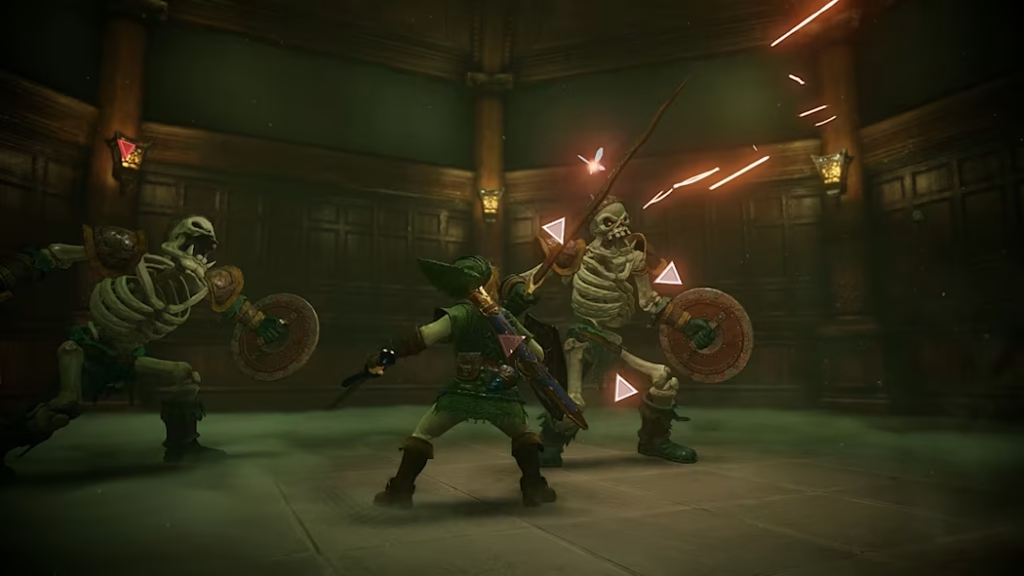
Zelda Ocarina of Time Characters: Complete Character Guide
Characters are a major reason Ocarina of Time remains memorable. The adventure connects Link with different communities, including the Kokiri, Gorons, and Zora, while building toward a conflict with Ganondorf.
Nintendo’s remake page highlights Link, Navi, Princess Zelda, Ganondorf, Impa, Saria, Darunia, and Ruto. The descriptions below also include other important characters from the original game, although Nintendo has not published a complete character-by-character remake roster.
Link
Link is the protagonist and the hero at the center of the adventure. At the beginning of the story, he lives in Kokiri Forest and is summoned by the Great Deku Tree to undertake a dangerous quest.
His journey spans two different eras, with childhood and adulthood shaping the way he explores Hyrule. Link must collect important items, solve dungeon puzzles, confront powerful enemies, and ultimately oppose Ganondorf.
His courage and willingness to help others make him central to the story’s themes of responsibility and heroism.
Princess Zelda
Princess Zelda is the young ruler of Hyrule’s royal family. She recognizes the danger surrounding Ganondorf and attempts to protect her kingdom from his ambitions.
Her knowledge of the threat helps set Link’s quest in motion. She is more than a character waiting to be rescued; her decisions and connection to the kingdom are essential to the story.
Ganondorf
Ganondorf is the principal antagonist. As the leader of the Gerudo, he seeks the Triforce, a legendary object associated with the powers of wisdom, power, and courage.
His ambition threatens Hyrule and drives the central conflict. The struggle between Ganondorf and Link establishes the stakes for the entire adventure.
Navi
Navi is Link’s fairy companion. She accompanies him throughout the quest and provides guidance, reminders, and information about enemies and objectives.
Navi is especially important early in the adventure because she helps Link learn how to respond to challenges. The character is also closely associated with the original game’s distinctive guidance system.
Sheik
Sheik is a mysterious warrior associated with the Sheikah and helps Link during the later stages of his journey.
Story spoiler: Sheik is Princess Zelda in disguise. This identity connects the character to Zelda’s efforts to survive and support the resistance against Ganondorf.
The character’s appearance and role are closely tied to the story’s revelations, so first-time players may prefer to experience the game before reading additional plot details.
Saria
Saria is a Kokiri girl and Link’s childhood friend. She lives in Kokiri Forest and shares a close connection with Link through their upbringing.
Music is an important part of her character, and her relationship with Link helps establish the emotional foundation of the early story.
Darunia
Darunia is the leader of the Gorons, a people who live around Death Mountain. His initial distrust of Link reflects the difficulties facing his community.
As Link helps the Gorons, Darunia becomes an important ally. His role connects the adventure to Death Mountain and the Fire Temple storyline.
Princess Ruto
Princess Ruto belongs to the Zora, an aquatic people associated with the kingdom’s rivers and waterways.
Her connection to Jabu-Jabu and the Zora storyline makes her an important character in Link’s journey. She also becomes connected to the larger conflict involving the Sages.
Impa, Rauru, and Nabooru
Impa is Princess Zelda’s attendant and a member of the Sheikah. She helps protect Zelda and has a connection to the wider history of Hyrule.
Rauru is the Sage of Light. He provides important guidance after Link pulls the Master Sword and discovers the consequences of Ganondorf’s actions.
Nabooru is a Gerudo warrior who opposes Ganondorf’s ambitions. Her role illustrates that not every member of the Gerudo supports the antagonist.
Other Important Characters
Several supporting characters contribute to Hyrule’s personality and the game’s side stories.
The Great Deku Tree is an ancient guardian whose call begins Link’s adventure. Mido is a Kokiri resident who initially makes life difficult for Link. Malon and Talon are associated with Lon Lon Ranch, while Epona becomes Link’s trusted horse.
Twinrova, the twin witches Koume and Kotake, serve Ganondorf and become important adversaries late in the original story. Kaepora Gaebora is an owl who offers Link advice throughout the adventure.
Main Character Guide
| Character | Role in the Story | Affiliation or Connection | Importance |
|---|---|---|---|
| Link | Main protagonist | Hero of Hyrule | Protects the kingdom |
| Princess Zelda | Royal ally | Royal family of Hyrule | Warns Link about Ganondorf |
| Ganondorf | Main antagonist | Leader of the Gerudo | Seeks the Triforce |
| Navi | Fairy companion | Link’s guide | Provides guidance |
| Sheik | Mysterious warrior | Sheikah disguise | Helps Link |
| Saria | Childhood friend | Kokiri Forest | Connects Link to his early life |
| Darunia | Goron leader | Death Mountain | Becomes an important ally |
| Princess Ruto | Zora princess | Zora community | Key character in the Zora storyline |
| Impa | Protector and guide | Sheikah | Protects Zelda |
| Rauru | Sage of Light | Sacred Realm | Explains Link’s destiny |
| Nabooru | Gerudo warrior | Gerudo people | Opposes Ganondorf |
| Great Deku Tree | Ancient guardian | Kokiri Forest | Begins Link’s quest |
| Malon | Ranch character | Lon Lon Ranch | Connected to Epona |
| Talon | Ranch owner | Lon Lon Ranch | Supports the ranch storyline |
| Twinrova | Antagonists | Ganondorf’s allies | Important late-game enemies |
Zelda Ocarina of Time Story Explained
Spoiler warning: This section describes major events from the original game.
The story begins in Kokiri Forest, where Link lives among the Kokiri. Unlike the other children, he has no fairy companion until Navi arrives and guides him to the Great Deku Tree.
The ancient guardian reveals that Hyrule faces a growing threat. Link is sent on a quest that eventually connects him with Princess Zelda, the Spiritual Stones, and the Ocarina of Time.
Zelda fears Ganondorf’s ambition to claim the Triforce. Link’s early journey involves collecting important items and learning more about the danger facing the kingdom.
The story changes dramatically when Link enters the Temple of Time and pulls the Master Sword. He becomes separated from his childhood era and awakens years later, when Ganondorf’s influence has transformed Hyrule.
Link must then visit temples, confront dangerous enemies, and awaken the Sages. These allies are vital to the final effort to stop Ganondorf.
The ocarina remains a key part of progression. Different melodies can affect the environment, help Link travel, or trigger important events. The game’s puzzles and dungeons repeatedly ask players to connect musical knowledge with exploration.
The conclusion brings Link into a final confrontation with Ganondorf. The conflict reinforces the story’s central themes: courage, responsibility, friendship, and the consequences of seeking power without regard for others.
Nintendo’s 2026 materials describe the remake as a return of this classic adventure. Although the remake introduces expanded dialogue and presentation changes, a substantially different main storyline has not been confirmed.
Zelda Ocarina of Time Remake Gameplay
The remake retains the identity of an action-adventure game built around exploration, combat, puzzle-solving, and progression through Hyrule.
Exploration of Hyrule
Hyrule Field connects a variety of environments, including settlements, forests, mountains, a lake, and desert regions. Exploring these areas reveals characters, hidden items, paths, and challenges.
Nintendo’s remake page highlights the new ability to run and jump more freely, which should make moving through the environment feel more flexible than in the original game.
Players can also ride Epona, Link’s horse, during the adventure. This relationship with the world is part of the classic game’s identity.
Combat and Weapons
The original adventure uses sword combat, shields, targeting, and a variety of equipment. Different enemies require players to observe attack patterns and choose appropriate ways to respond.
The Master Sword is particularly important to the storyline, while other equipment helps Link navigate obstacles and solve puzzles.
Nintendo has announced more responsive actions and updated controls for the remake, but detailed balance changes and the complete final control layout should be verified from the finished game.
Ocarina Music and Its Role
The ocarina is more than a musical item. Link learns melodies that can affect his surroundings and help him progress through the story.
Some songs trigger events, while others support navigation or reveal ways to interact with the world. Learning when and where to use a melody becomes part of the game’s puzzle design.
The remake’s additional microphone feature lets players hum learned melodies for Link to play in-game. ZELDA NOTES also includes a virtual ocarina, adding an optional way to engage with the music.
Time Travel and Progression
Link’s journey spans childhood and adulthood, changing how he can interact with Hyrule.
Some characters, locations, and challenges differ between these eras. Progress in one period can influence events later, creating puzzles that depend on understanding the passage of time.
This structure is a major reason the original game remains distinctive among action-adventure titles.
Dungeons, Bosses, and Challenges
Dungeons combine combat, navigation, environmental puzzles, and boss encounters. Players must often discover special items or learn the mechanics of a location before reaching its central challenge.
The Forest Temple, Fire Temple, Water Temple, and other major locations each present different obstacles. Boss encounters then test the player’s ability to observe patterns and apply the tools collected during the adventure.
The remake’s official announcement has not confirmed a new set of dungeons or remake-exclusive bosses. It is more accurate to discuss the established original-game structure and distinguish it from any later confirmed additions.
Ocarina of Time Remake vs Original Game
The following comparison summarizes the original Nintendo 64 release against the changes Nintendo has announced for the 2026 remake.
Remake vs Original
| Feature | Original Nintendo 64 Version | New Remake |
|---|---|---|
| Original release | 1998 | November 5, 2026 |
| Platform | Nintendo 64 | Nintendo Switch 2 |
| Visual presentation | Original-era 3D graphics | Completely overhauled visuals |
| Character dialogue | Primarily text-based presentation | Expanded dialogue |
| Cutscenes | Original presentation | Fully voiced cutscenes |
| Music | Original soundtrack | Symphonic orchestral music and refreshed sound |
| Movement | Original control design | New jump and run commands |
| Camera | Original camera system | Improved right-stick camera control |
| Loading and performance | Original hardware experience | Faster loading and smoother performance, according to Nintendo |
| Day/night cycle | Original behavior | Cycle continues even in towns |
| Progress tracking | Original in-game structure | Threads of Time progress feature |
| Additional assistance | Original game guidance | ZELDA NOTES app features |
One important distinction is that the remake should not be treated as the first time Ocarina of Time has ever been modernized. The Nintendo 3DS edition from 2011 already updated aspects of the original experience.
The 2026 remake is a separate new release designed specifically for Nintendo Switch 2. Nintendo has announced a broader visual overhaul and several additional changes, but it has not provided a complete technical comparison against every previous edition.
Will the Remake Include New Characters or Story Changes?
Nintendo has confirmed expanded character dialogue, voiced cutscenes, updated environments, and other gameplay improvements. These changes make the story presentation more detailed, but they do not automatically establish that the underlying plot has been rewritten.
At the time of writing, Nintendo’s public materials do not establish a completely new main storyline, additional ending, or a new roster of major characters. The official remake page presents familiar characters from the original adventure.
Players should be cautious about rumors claiming that the remake includes entirely new dungeons, extra playable characters, or substantial story alterations unless Nintendo or another reliable source confirms them.
The most reliable expectation is a recognizable Ocarina of Time adventure with significant presentation and control improvements, while the full extent of any additional content should be assessed from official information and the finished game.
Is Zelda Ocarina of Time Remake Worth Playing?
For returning players, the remake offers an opportunity to revisit a familiar adventure with updated visuals, a new soundtrack, voiced cutscenes, and modernized movement. Those improvements could make the world and its characters more engaging for players who already know the original.
For newcomers, the game’s structure offers an entry point into The Legend of Zelda series. It combines a clear central quest with exploration, memorable characters, puzzles, and a story that spans two eras.
Players who prefer modern open-world games should understand that Ocarina of Time is built around a more structured adventure with carefully designed dungeons and progression. Its appeal comes from connecting exploration to puzzle-solving and story developments rather than providing an entirely unrestricted world.
Since the remake has not yet reached its announced release date, a final judgment about its overall quality should wait for the finished product and independent reviews.
Zelda Ocarina of Time Remake Price and Preorder
Nintendo’s U.S. storefront lists the game at $59.99. Nintendo has also announced a physical version with special textured foil packaging for the first print run, while supplies last.
Regional prices, taxes, shipping charges, retailer offers, and physical-edition availability may differ. Buyers outside the United States should check the relevant Nintendo store or an authorized regional retailer rather than converting the U.S. amount and assuming it will match the local price.
The official release date remains November 5, 2026. Players considering a preorder should review the edition, platform compatibility, delivery terms, and cancellation conditions before completing a purchase.
Official information and purchasing links are available through the Nintendo Store.
Frequently Asked Questions
When is Zelda Ocarina of Time Remake releasing?
Nintendo has announced November 5, 2026, as the release date for the remake.
Which platform will support the remake?
The game has been announced exclusively for Nintendo Switch 2. Nintendo has not announced a version for PlayStation, Xbox, or PC.
Who are the main characters in Ocarina of Time?
The main characters include Link, Princess Zelda, Ganondorf, Navi, and Sheik. Important supporting characters include Saria, Darunia, Ruto, Impa, Rauru, and Nabooru.
Is the remake different from the original game?
Yes. Nintendo has announced overhauled visuals, voiced cutscenes, expanded dialogue, orchestral music, modernized camera controls, and new movement options.
Will the remake include voice acting?
Yes. Nintendo confirms fully voiced cutscenes and expanded character dialogue. Its announcement does not establish that every piece of dialogue in the game will be voiced.
Is Ganondorf the main villain?
Yes. Ganondorf is the central antagonist whose ambition to obtain the Triforce threatens Hyrule.
Will the remake introduce a new story?
Nintendo has not confirmed a substantially new main storyline. Its official descriptions focus on improving the classic adventure’s presentation and gameplay.
How much does Zelda Ocarina of Time Remake cost?
Nintendo’s U.S. listing shows a price of $59.99. Prices and edition availability may vary by region.
Can newcomers play without earlier Zelda games?
Yes. Ocarina of Time tells a largely self-contained adventure, so prior knowledge of the series is not necessary to follow Link’s main quest.
Where can players find official release and purchase information?
The most reliable starting point is Nintendo’s official game listing and its 2026 announcement.
Conclusion
The Zelda Ocarina of Time Remake is a significant return for one of Nintendo’s most recognizable adventure games. Its November 5, 2026, release will bring the classic journey to Nintendo Switch 2 with overhauled visuals, voiced cutscenes, orchestral music, more flexible movement, improved camera controls, and additional support through ZELDA NOTES.
Link’s journey through Hyrule, his relationship with characters such as Navi and Princess Zelda, and his conflict with Ganondorf remain at the center of the experience. The announced changes focus on making that adventure more accessible and immersive for a new generation while retaining its established identity.
For returning fans, it offers a new presentation of a familiar story. For newcomers, it may provide a convenient way to discover an important entry in the Zelda series. The remaining question is how these improvements feel during extended play, something that will become clearer when the finished game is available.